
Heading
Six levels of heading, and the rule under an h1.
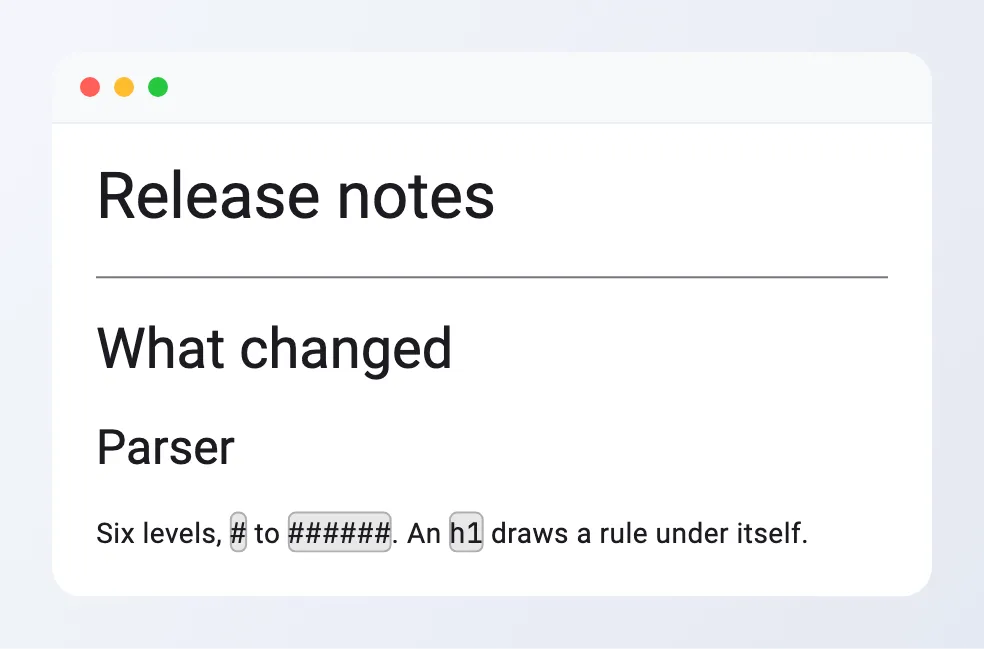
# Release notes
## What changed
### Parser
Six levels, `#` to `######`. An `h1` draws a rule under itself.
Syntax
Section titled “Syntax”# to ###### start a heading; closing #s are optional. A line underlined
with === or --- is a heading too (setext), which is why a --- directly
under text makes a heading rather than a rule — leave a blank line before a
horizontal rule.
Sizes come from GptMarkdownThemeData’s h1 to h6, which default to the
Material text theme; HeadingStyle changes everything else.
Styling
Section titled “Styling”GptMarkdown( text, styleSheet: const GptMarkdownStyleSheet( heading: HeadingStyle( textStyle: TextStyle(letterSpacing: -0.5), padding: EdgeInsets.only(top: 8, bottom: 4), showDivider: false, ), ),)textStyle is merged over the per-level style, so you change one property
without restating the size. Per-level sizes still come from the theme:
GptMarkdownThemeData( brightness: Brightness.light, h1: Theme.of(context).textTheme.headlineMedium, h2: Theme.of(context).textTheme.titleLarge,)showDivider: false removes the rule an h1 draws by default. Leave it null
to keep following autoAddDividerLineAfterH1.
Restructure with a builder — for example, anchors on every heading:
GptMarkdown( text, headingBuilder: (context, level, content, style) => Row( crossAxisAlignment: CrossAxisAlignment.baseline, textBaseline: TextBaseline.alphabetic, children: [ Flexible(child: content), IconButton(icon: const Icon(Icons.link), onPressed: () {}), ], ),)level is 1–6, so one builder handles all six.
API reference
Section titled “API reference”HeadingStyle
Section titled “HeadingStyle”How a # heading is drawn.
Set it as GptMarkdownStyleSheet(heading: HeadingStyle(…)) on the widget, or in GptMarkdownThemeData for the whole app. Every field is optional; an unset one falls back to the theme, then to the default.
| Field | Type | Description |
|---|---|---|
textStyle |
TextStyle? |
Applied on top of the level style from the theme. |
padding |
EdgeInsetsGeometry? |
Space around the heading. Defaults to none. |
showDivider |
bool? |
Whether a rule is drawn under the heading. |
dividerColor |
Color? |
Colour of that rule. |
dividerThickness |
double? |
Thickness of that rule. |
dividerPadding |
EdgeInsetsGeometry? |
Space around that rule. |
| Member | Type | Description |
|---|---|---|
merge(HeadingStyle? other) |
HeadingStyle |
This style, with any unset field taken from other, field by field. |
resolve(ColorScheme scheme) |
HeadingStyle |
This style with every remaining default filled in. |
copyWith({…}) |
HeadingStyle |
A copy with the given fields replaced. |
static lerp(HeadingStyle? a, HeadingStyle? b, double t) |
HeadingStyle? |
Linearly interpolates between two styles. |
resolve: more
Heading defaults live on GptMarkdownThemeData as h1-h6,
autoAddDividerLineAfterH1 and the hrLine* fields. Anything left null here
keeps using those, so existing themes keep working unchanged.
headingBuilder
Section titled “headingBuilder”Replaces the whole heading widget, including the rule an h1 draws.
Reach for styleSheet first — HeadingStyle covers the text style,
padding and the rule without giving up the default structure.
typedef HeadingBuilder = Widget Function( BuildContext context, int level, Widget content, HeadingStyle style,);